

SUBSCRIBE TO OUR
MAILING LIST
Thank you! Your submission has been received!
Oops! Something went wrong while submitting the form.

The Situation
Leadership transitions are accelerating across the community development field as many founders and long-time leaders retire.
A new wave of community bankers — deeply connected to their communities through shared identity and lived experience — is stepping up, bringing assets like trust, cultural competence, and local accountability. Yet these leaders often face systemic barriers and “glass cliff” scenarios, stepping into challenging roles with limited support and flexibility. Collectively managing over $2 billion in assets spanning small business loans, affordable housing, homeownership, and financial education, their success is critical: fortifying these leaders shows that production, profit, participation, and shared value can grow together when structured support is provided. It's not just their careers at risk, it's the economic futures of entire communities.
The Solution
Proximate Leaders was created to provide support to these new leaders through their transitions.
With research from the Bridgespan Group and support from the Robert Wood Johnson Foundation, we launched Proximate Leaders, an initiative to provide wraparound support to five high-potential leaders during the critical early years leading their respective institutions. The initiative aims to demonstrate that with flexible resources, peer community, and strategic support, proximate leaders can thrive and their success can activate local ecosystems and shift how the field approaches leadership transitions.
Proximate Leaders Framework:

Peer Community: Monthly convenings creating space for collective problem-solving and shared learning
Strategic Connections: Opening doors to philanthropic and institutional networks
Flexible Support: Curating expertise—coaching, fundraising, governance, strategic planning—exactly when needed
Responsive Approach: Co-creating support with leaders rather than rigid programming
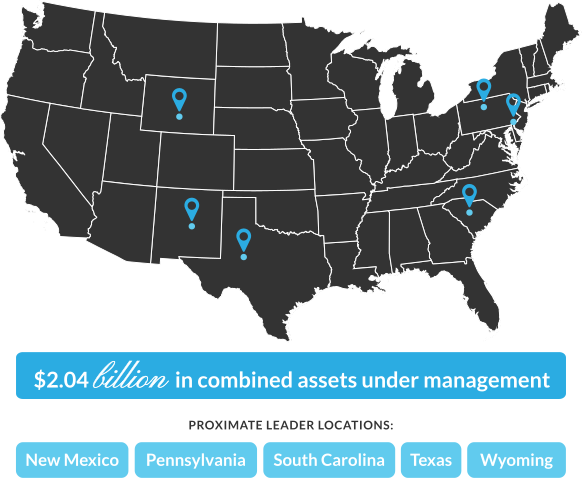
Focused on Native American, Black, Latinx, and working-class communities, Proximate Leaders supports five community development leaders with a combined $2.04 billion in assets under management.
Leaders face predictable patterns of heightened scrutiny, inherited organizational challenges, and dynamics rooted in bias. These require intentional, sustained support to address.
Leaders need peer community, executive coaching, capitalization strategy, fundraising support, and strategic planning—but the combination and timing varies by context. One-size-fits-all programming fails.
Political and economic landscapes directly impact how proximate leaders can operate and what support they need. Effective support requires responsiveness to these changing conditions.
When leaders feel safe sharing real challenges, meaningful support becomes possible. Building that trust requires demonstrating flexibility, respecting agency, and centering leaders' voices.

The five leaders in our cohort have already demonstrated remarkable impact—doubling loan portfolios, securing major grants, launching new community programs, rebuilding leadership teams, and expanding services. Their success activates local ecosystems and shows what’s possible when proximate leaders receive the support they deserve.
But this is just the beginning. Proximate Leaders is more than an initiative, it’s a model for how the field can support leadership transitions. We continue following these leaders, documenting learnings, and building the case for sustained investment in proximate leadership. By making our approach replicable, shifting narratives about the value of proximate leaders, and advocating for systemic change, we aim to ensure that future leaders have the infrastructure, relationships, and resources they need to thrive. Supporting five leaders today is the first step toward transforming how community development institutions approach leadership transitions.
The goal is to transform how community development institutions approach leadership transitions, ensuring that future proximate leaders have the infrastructure, relationships, and resources they need to thrive.
